Today's humanity is a photography factory: according to Photutorial, we take 5.3 billion photos a day, which is more than 60 thousand in a single second.¹ Let's look at one more for the collection:
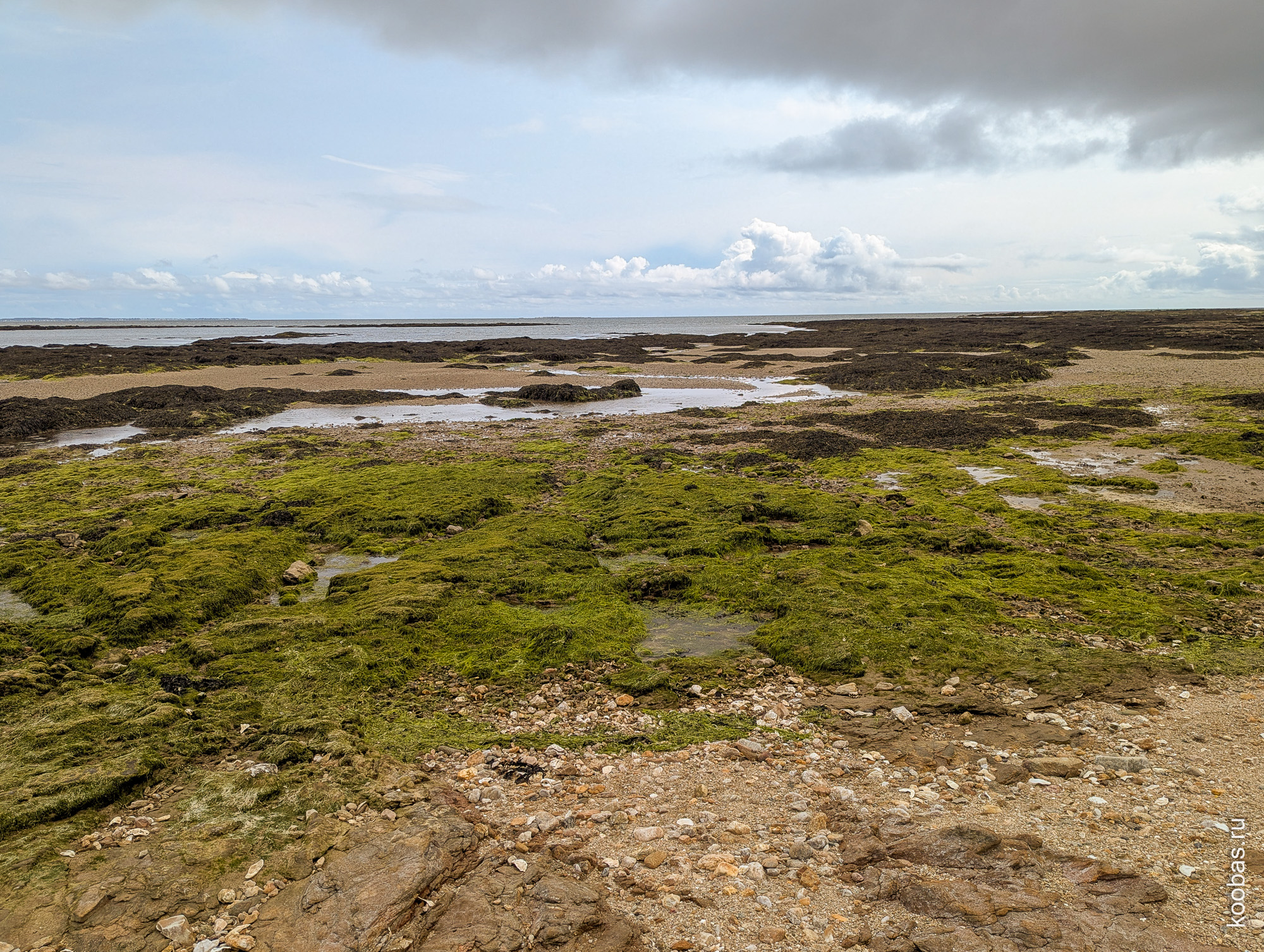
(the source of this and other photographs in the article is Damgan, unless stated otherwise)
Les algues vertes and Green Algae
It is obvious that we do not have enough space for commentary here: it is just another photograph by the author of this essay from his vacation. The location of the picture, its time, and context probably do not evoke any specific feelings in the reader. There are stones by the water, probably summer, probably outside the city. But in the era of fast content, this photograph is perhaps too slow, lacking spark, unsalted (though whether the water in question is actually salty cannot be determined with the naked eye).
Each of us faces this problem on a personal level as well. Years ago, I found myself in a situation where thousands of photographs, taken by me during a few years in emigration, just lay pointlessly on a hard drive. That is how Travel came to be, where I decided to describe every new city I have seen over more than ten years. The whole process (ritual?) is meditative: in a new place, I take as many photos as possible and don't think too much. At home, I go through hundreds of new images and try to select only those that evoke emotions or memories. Sometimes I ask my loved ones if they have any interesting associations. At the end, I add text, and in this way, hundreds of fast photographs become one slow article.
A slow article can sometimes reveal what is missing in a fast snapshot. The saltiness of the water cannot be read from pixels; it requires a different kind of gaze. The "mere eye" is not enough. This expression can be translated into Russian as "невооруженный глаз", literally the "unarmed eye". When Johannes Kepler and Galileo Galilei pointed the first telescopes at the sky, they needed to linguistically separate natural vision from instrumental vision. At first, they relied on terms like perspicillum or instrumentum.² However, as the 17th-century optical revolution progressed, natural philosophers began to perceive the optical instrument as armor that strengthens human biological limits. For example, Robert Hooke described telescopes and microscopes as "artificial organs" compensating for the defective "unarmed eye."³ Thus arose the Latin opposition: oculus armatus (the armed eye) and oculus inermis (the defenseless, unarmed eye), alongside which the variant nudo oculo (with the naked eye) also existed in parallel, which astronomers like G. B. Riccioli explicitly contrasted with instruments in their treatises.⁴
European languages divided when translating Latin concepts into at least two groups that reflect different understandings of the relationship between humans and technology. For example, in English, it is the "naked eye", in French "à l'œil nu" (with the naked eye); in Spanish "a simple vista" (with a simple look).
Nicholas Mirzoeff shows that the climate crisis is not invisible, it just requires an "armed" gaze. He describes how we can "arm" our eye so that we see more than what is simply visible. For example, when we look into the world of Claude Monet, many of us see only the aesthetics and beauty of his paintings, but when we arm ourselves with the history of his time, we discover that he lived during the industrial revolution. We learn that the choice of colors (and thus perhaps Monet's entire style) was not accidental: we see omnipresent smoke and smog.⁵
Because of this thought, my question arose: what is not visible in my photograph? Unfortunately, living in Prague will not help explain seascapes, so I had no choice but to ask the locals: "What do you see in this picture?" (See the first picture in the article.) The vast majority of the answers sounded like "nothing, just green algae" (in French "Rien de spécial, les algues vertes"). Interestingly, my naked eye, on the contrary, saw only the sea: the photograph from the Breton town of Damgan seems empty at first glance.
For the inhabitants of Brittany (unlike tourists), green algae no longer belong to the sphere of biology, but to the sphere of politics.
I started by finding out that "green algae" are not "just algae" for the people of Brittany. As we can see from Google Trends,⁶ the French are much more interested in them than Czechs. Why? Green algae (French "algues vertes"), specifically species of the genus Ulva (known in English as sea lettuce), are infamous in Brittany due to a massive ecological phenomenon known as "green tides" (marées vertes). This problem represents one of the largest environmental and political crises in the modern history of this French region.
Green tides do not appear on their own. They are the result of agricultural pollution. Breton intensive agriculture, especially pork and poultry production, produces huge amounts of manure and slurry. Brittany covers only about 7% of France's agricultural land, but produces almost 55% of French pork and a huge share of poultry.⁷ The nitrates from this fertilizer wash into the sea through rivers and streams, where they serve as an extremely strong nutrient for algae. Every summer, currents wash hundreds of thousands of tons of this biomass onto the beaches. When the layer of algae dries in the sun, it forms an impermeable crust. The algae underneath begin to rot. A byproduct of this process is hydrogen sulfide, a gas smelling of rotten eggs, which is highly toxic in high concentrations. Inhaling the released hydrogen sulfide from rotting pockets of algae, which a person or animal steps into, can cause flash unconsciousness and death. Several deaths of wild animals, dogs, horses, and unfortunately also several humans (for example, workers clearing the algae) have been documented in Brittany in this way.
I learned about this whole story from an investigative graphic novel by journalist Inès Léraud.⁸ Her work uncovered the pressure of the agricultural lobby, the silencing of toxicological reports, and the state's unwillingness to investigate deaths on the beaches—such as the case of driver Thierry Morfoisse or the jogger in the Saint-Michel-en-Grève bay.⁹ The comic book as a genre is one of the most popular and effective "weapons" for the eye of today's Frenchman.
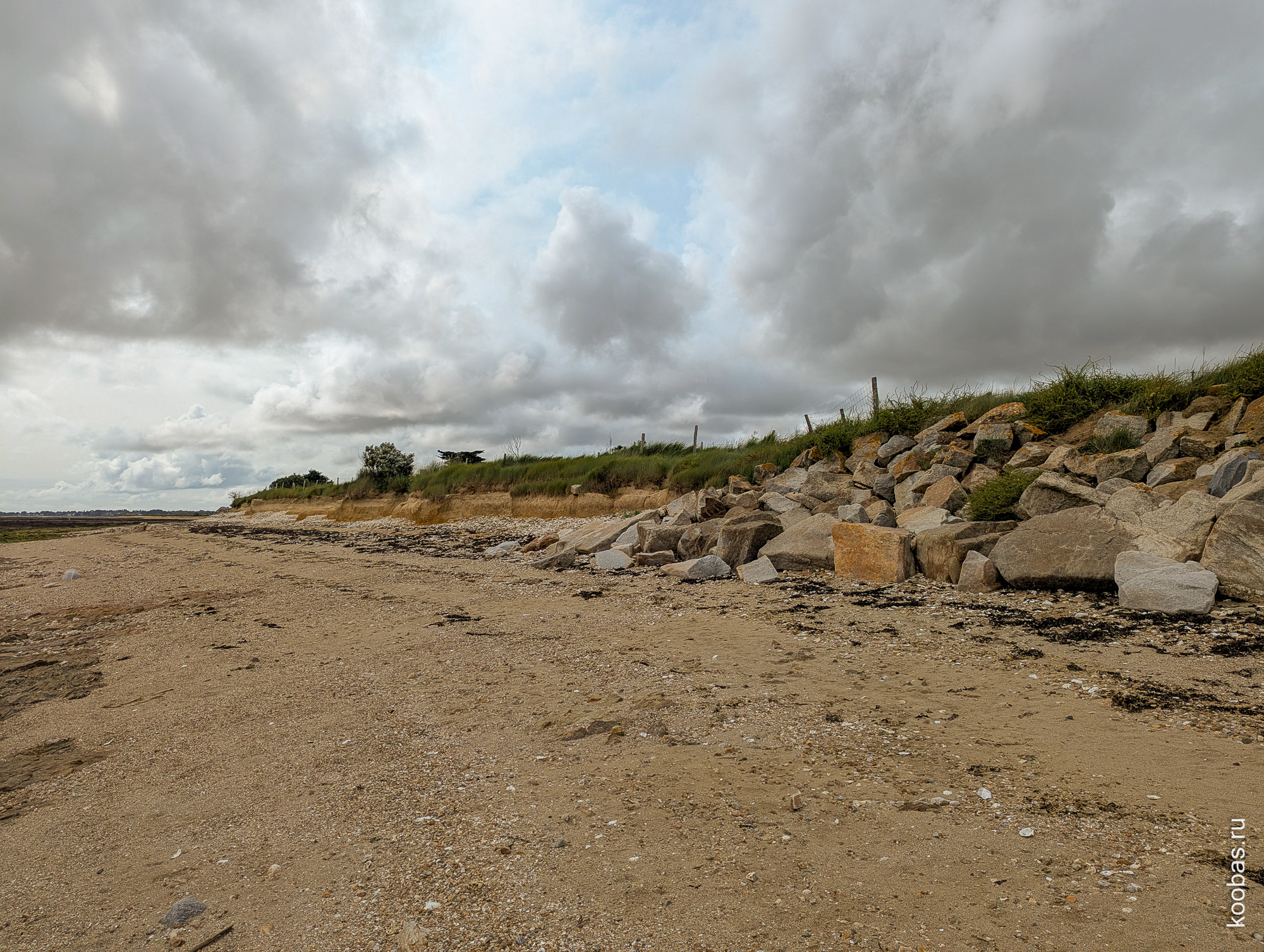
Let's look at another photograph from this vacation (stones again, of course, but larger):
Stones and the Capital(ocene)
While green algae reveal the limits of our perception of biology, examining coastal barriers shows the limits of our reading of the landscape. A sudden interruption of a stone wall is not the work of erosion. It is the boundary line of human bureaucracy.
To begin with, locals told me that those stones are not there naturally. They are the result of human activity, specifically the effort to preserve the coastal boundaries. However, it is not clear why the preservation does not take place along the entire coastline: the locals' assumption was that one can apply for the stones. At home, I armed myself with sources and found out that one can indeed apply for this type of fencing. However, it is not free in all cases: sometimes it is necessary to invest a certain amount in advance, so the state only helps partially.¹⁰
These asymmetrical deposits of boulders make no natural sense. They are a perfect physical manifestation of what Donna Haraway calls the Capitalocene: an epoch where the driving engine of planetary change is the commodification of nature.¹¹ The state does not systematically defend this coast against erosion and rising sea levels according to ecological needs, but as a paid service. The shoreline thus ceases to be a geological formation and becomes a topography of private capital: only that stretch of coast whose owner has invested in the arming is protected.
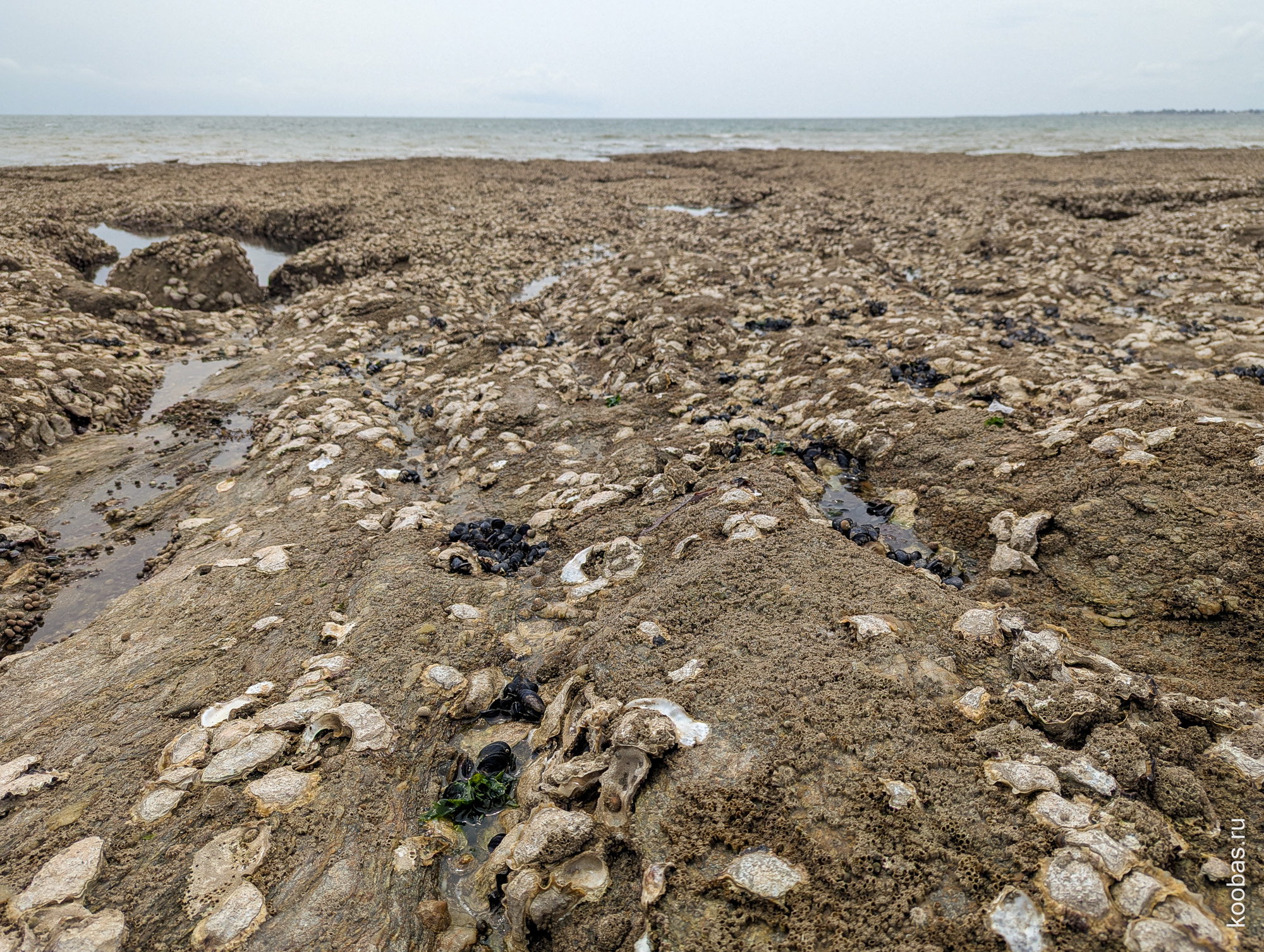
The last photograph for which I had to arm my eye was this one:
Shells on a Wing
I am sure a reader will know the names of multiple species from the picture, but to me they were just "shells". A Breton, however, would most likely recall for example: "huîtres, moules, bigorneaux, bernique, coques, palourdes, gibbules, couteaux, bulots, crépidules" and others. They are probably not all in the picture, but this entire vocabulary is commonly used. Knowledge of context and language is, of course, a powerful weapon for our eye. However, the truly most experienced can learn, for example, about the route of objects lost in the ocean.
Marine investigators use small marine animals called barnacles (more precisely, pelagic gooseneck barnacles, Lepas anatifera; they are not in the picture, but look similar), which like to attach themselves to any floating debris. The calcareous shell of barnacles grows continuously. Every day, one tiny layer is added to it, which works exactly like tree rings. When a barnacle forms a new layer of its shell, it stores oxygen isotopes from the surrounding water in it. The ratio of these isotopes changes depending on how warm or cold the water is. Each daily layer thus permanently locks in information about the ocean temperature at a given moment.¹² Scientists used this technique in the search for the MH370 aircraft. The armed eye no longer sees just debris washed up by the tide, but a biological black box.
The Armor of Knowledge
These are just three short stories about how to slow down such a paradoxically fast medium as photography. Of course, there are endless other methods, but meaningfully arming the eye with French, comics, ethnography, bureaucratic research, and forensic analysis is just one of the ways to see the world around us.
Sixty thousand captured images per second do not allow the gaze to linger. The naked eye sees only green water, a pile of boulders, and shattered shells. The dizzying creation of images has stripped us of the necessity to read their depth. Therefore, we do not need armor in the form of knowledge for defense, but to truly stop time.
References
¹ Broz, Matic. 2025. "Photo statistics: How many photos are taken every day?" Photutorial. Last modified May 2025. https://photutorial.com/photo-statistics/.
² Rosen, Edward. 1947. The Naming of the Telescope. New York: Henry Schuman, 2–3.
³ Aït-Touati, Frédérique. 2011. Fictions of the Cosmos: Science and Literature in the Seventeenth Century. Translated by Susan Emanuel. Chicago: The University of Chicago Press, 135; Hooke, Robert. 1674. An Attempt to Prove the Motion of the Earth from Observations. London: T.R. for John Martyn, 9.
⁴ Riccioli 1651, quoted in Graney, Christopher M. 2010. "Seeds of a Tychonic Revolution: Telescopic Observations of the Stars by Galileo Galilei and Simon." Physics in Perspective 12, no. 1: 13.
⁵ Mirzoeff, Nicholas. 2018. Jak vidět svět [How to See the World]. Translated by Andrea Průchová Hrůzová and Jan J. Škrob. Prague: ArtMap, 229–31.
⁶ Google. n.d. "Google Trends Compare: algues vertes, Zelené řasy." Accessed May 7, 2026. https://trends.google.com/explore?q=algues%20vertes,Zelen%C3%A9%20%C5%99asy&date=all&geo=Worldwide.
⁷ Direction régionale de l'alimentation, de l'agriculture et de la forêt (DRAAF) de Bretagne. 2025. "Les productions animales [Mémento 2025]." Ministère de l'Agriculture, de la Souveraineté alimentaire et de la Forêt. Accessed May 7, 2026. https://draaf.bretagne.agriculture.gouv.fr/les-productions-animales-memento-2025-a3744.html.
⁸ Léraud, Inès, and Pierre Van Hove. 2019. Algues vertes : L'histoire interdite. Paris: La Revue Dessinée | Delcourt.
⁹ Léraud, Inès, and Pierre Van Hove. 2019. Algues vertes : L'histoire interdite. Paris: La Revue Dessinée | Delcourt, 12, 36–38.
¹⁰ ARTELIA. 2018. Etude de protection du littoral communal de Damgan : Réunion publique du 28 août 2018. ARTELIA Maritime, 17.
¹¹ Haraway, Donna J. 2016. Staying with the Trouble: Making Kin in the Chthulucene. Durham: Duke University Press, 47–50.
¹² Al-Qattan, Nasser, Gregory S. Herbert, Howard J. Spero, Sean McCarthy, Ryan McGeady, Ran Tao, and Anne-Marie Power. 2023. "A stable isotope sclerochronology-based forensic method for reconstructing debris drift paths with application to the MH370 crash." AGU Advances 4: e2023AV000915. https://doi.org/10.1029/2023AV000915.